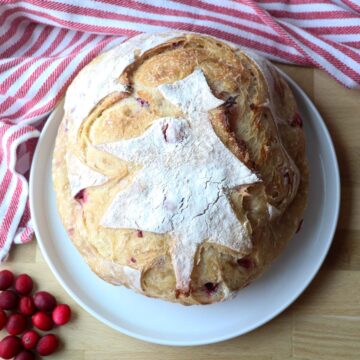
Cranberry Orange Walnut Sourdough Bread
This cranberry orange walnut sourdough bread is one of my favorite sourdough loaves to make especially at Christmastime.
Equipment
- 1 Large Mixing Bowl
- 1 Measuring cups
- 1 Danish whisk
- 1 Bench scraper
- 1 Bread Lame Scoring Tool or Razor Blade
- 1 Banneton proofing basket (you can also use a towel lined bowl - see video below)
- 1 parchment paper
- 1 Cast Iron Dutch Oven (optional)
Ingredients
- 1 ½ cups orange juice
- ½ cup sourdough starter
- 3 ½ cups flour
- 1 Tbl salt
- ½ cup dried cranberries
- ½ cup toasted walnuts
Instructions
Feed Starter
- Feed starter 4-12 hours before mixing up your dough
Toast Walnuts
- Toast the walnuts on a baking sheet for 15-20 minutes in a 350 degree oven to bring out their flavor.
Mix Ingredients
- In a large bowl, add orange juice, active sourdough starter and flour. Mix until it comes together into a shaggy dough. Leave it for 15-30 minutes to “autolyse”. This just means you’re giving the flour a chance to absorb the water and the starter.
- Add the salt and “mix” into the dough with a circular motion similar to how a mixer would mix the dough (see video below). Let sit for another 15-30 minutes.
Create Structure In Your Dough
- Begin creating structure in your dough by doing a series of stretch and folds, coil folds and/or lamination every 15-30 minutes. You will know your dough has good structure when it holds it shape and starts getting some bubbles on top. Sometimes I only do 2-3 stretch and folds before letting it bulk ferment if I’m in a hurry, but I try to also do 2-3 coil folds and one lamination.
Bulk Ferment
- Cover bowl with a loose fitting lid like a plate and leave it in the bowl at room temperature for 2-3 hours to bulk ferment.
Shape
- Turn dough out onto the counter. If making more than one loaf at a time, divide the dough with a bench scraper. Wet your hands so the dough doesn’t stick to them, and gently spread dough out in a rectangle as thin as you can without tearing it. Take ⅓ of the dough from one side of the rectangle and fold it towards the middle. Do the same with the other side of the dough, bringing it to the center. Roll up the dough into a ball and create surface tension on the ball by pushing it away from you and then pulling it back towards you several times. (See video). Cover with a damp towel and let the dough rest on the counter for 15-20 minutes.
- Turn the dough ball back over and spread it out in a rectangle again. It won’t spread as far this time because it will remember it’s shape from the first time. Spread dried cranberries and toasted walnuts across the dough. Fold ⅓ dough towards the center again from each side and roll up as before. Create tension on the dough by pushing it away and pulling it towards you several times. This tension is what will help create good oven spring - which helps the dough rise in the oven instead of spreading out.
Cold Ferment
- Place dough upside down in a banneton or tea towel and flour lined bowl. Cover with cloth or plastic wrap and place in the refrigerator for 2-12 hours. Keep in mind that the dough will raise some while in the refrigerator, but it may not double in size like yeast bread. It does a lot of its raising while baking. Remember, this is very different than baking regular yeast bread.
Preheat Oven
- There are two ways you can bake this bread. In a dutch oven or without a dutch oven as an “open baked” loaf. Either method works well. If using the dutch oven method, be sure to place your dutch oven in your oven while it preheats to 450 degrees.
Score
- When oven is hot, take sourdough out of the refrigerator and dump it out onto a piece of parchment paper. Your dough should still be holding it’s shape. Brush gently with flour (rice flour makes the scoring stand out the best, but is optional). Score the top of the dough using a bread lame about ¼” deep using whatever designs you desire. I like to make a snowflake or Christmas tree on top of the dough for this walnut cranberry sourdough bread.
Bake
Dutch Oven Method
- Remove dutch oven from pre-heated oven. Remove lid and quickly place parchment paper with bread on it into the hot dutch oven. Replace lid and quickly place it back into the oven. Place a baking sheet on the rack under the dutch oven so the bottom of your bread doesn’t end up too hard and crusty.
Open Bake Method
- Place parchment paper with bread on it onto a baking sheet or pizza stone and place it into the oven. Below it place a baking sheet or pan and pour boiling water into it to create steam. This will help to give your bread a crispy crust with a fluffy inside and will replicate the dutch oven baking.
- Reduce heat to 425 degrees and bake for 25 minutes.
- Remove the lid if using a dutch oven.
- Bake for 15 more minutes until the loaf is a nice golden brown.
- Remove bread from oven and place on a cooling rack.
Slice and Enjoy
- For best results, wait until bread is cool to slice. Sometimes I can’t wait that long, and slice it sooner. The bread can look gummy if you slice it to soon, but it is so good with fresh butter that sometimes I do it anyway.
Notes
